
Reducing & Eliminating Desflurane Usage
Jump to:
Background Recommendations Benefits Processes Implementation History Resources and References
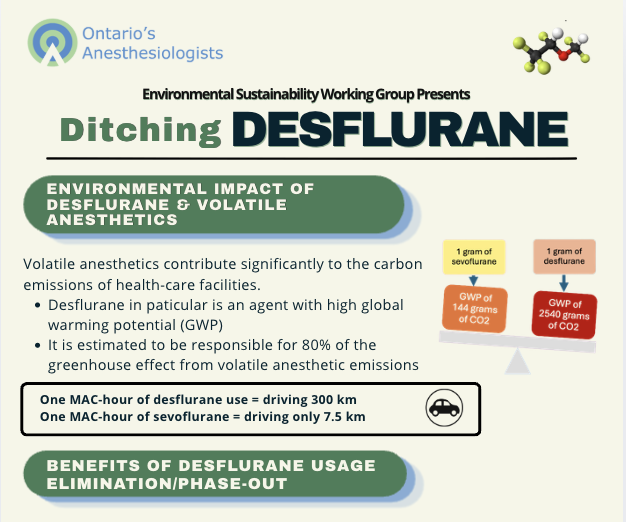
Review our INfographic which is not yet linked; once we like it i’ll add it here
Like other anesthetic gases, desflurane is detrimental to the environment. As a result, reducing or eliminating the use of desflurane can be an impactful approach to greening anesthesia and perioperative care.
If your hospital is interested in reducing costs and its environmental impact by eliminating desflurane usage, Ontario’s Anesthesiologists’ Environmental Sustainability Working Group is ready to help. We can provide resources, presentations and personal support from one of our members to help your greening efforts. Contact us today!
Background: Environmental Impact of Desflurane and Volatile Anesthetics
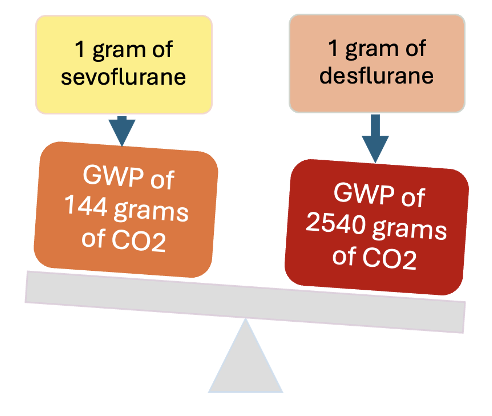
Desflurane is estimated to be responsible for 80% of the greenhouse effect from volatile anesthetic emissions.
Volatile anesthetics contribute significantly to the carbon emissions of healthcare facilities. In particular, desflurane has been identified as an agent with high global warming potential (GWP) of 2540: One gram of desflurane is the equivalent of 2,540 grams of carbon dioxide. This is roughly 20 times greater than that of sevoflurane, whose GWP is 144.
For reference, one MAC-hour of desflurane use is the estimated equivalent of driving 300 km, whereas one MAC-hour of sevoflurane is like driving only 7.5 km.
.
Recommendations
The following professional societies have released position statements regarding the reduction of harmful emissions, waste, and costs:
In November 2024, the Canadian Anesthesiologists’ Society released the following recommendations:
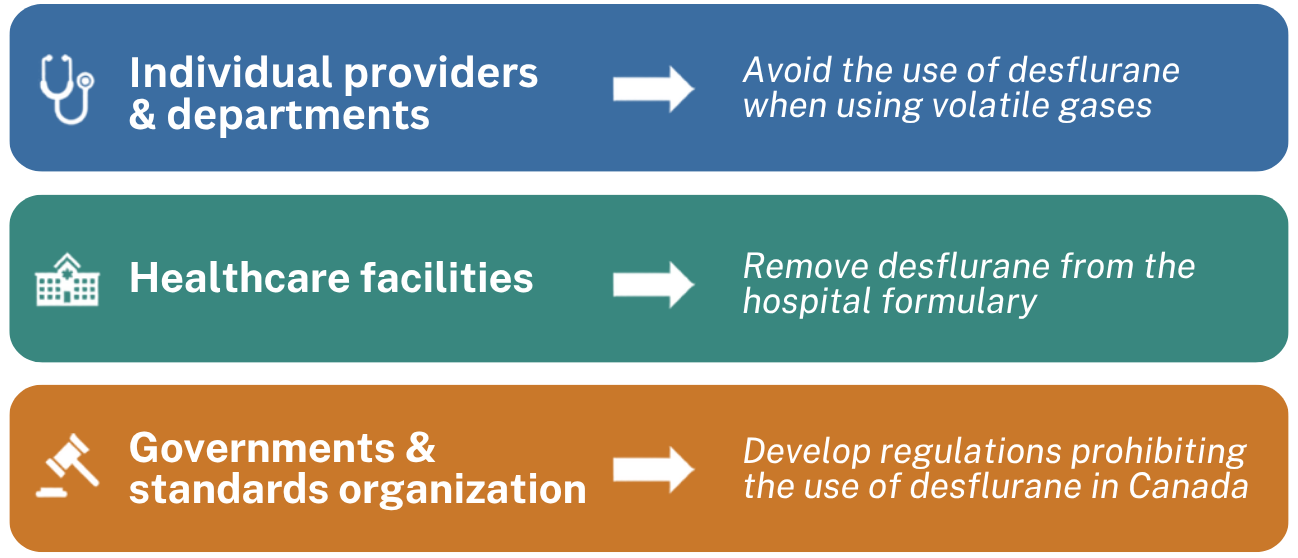
Benefits of Desflurane Usage Elimination/Phase-Out
Reducing/eliminating the use of desflurane is an opportunity To Reduce the environmental impact of perioperative and anesthetic care.
Several institutions have shown improvements in carbon-dioxide emissions through eliminating or phasing out desflurane. These improvements include:
Decreased carbon emissions
In British Columbia, a decrease in desflurane use lowered each health authority’s carbon footprint by more than 50%.
Similar patient outcomes
Concerns have been raised by some anesthesiologists that the phase-out of desflurane could have a negative clinical impact. A review by the National Institute for Health and Care Excellence has found no high-quality evidence to suggest that desflurane has any significant clinical or therapeutic advantage over other general anesthetic agents in patients undergoing neurological procedures or those with BMI greater than 30.
Processes for Desflurane Usage Elimination/Phase-Out
Developing an initiative to decrease desflurane usage and decrease anesthesia-related carbon emissions involves the use of multiple strategies.
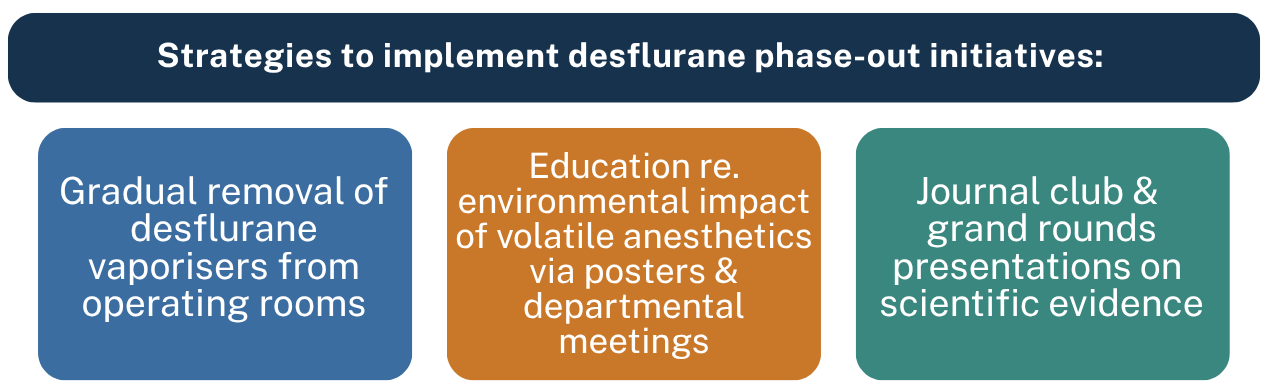
Strategies to implement desflurane phase-out may include:
Education regarding the environmental impact of volatile anesthetics at departmental meetings
And via distribution of posters
Journal club presentations on scientific evidence
Gradual removal of desflurane vaporizers from individual operating rooms
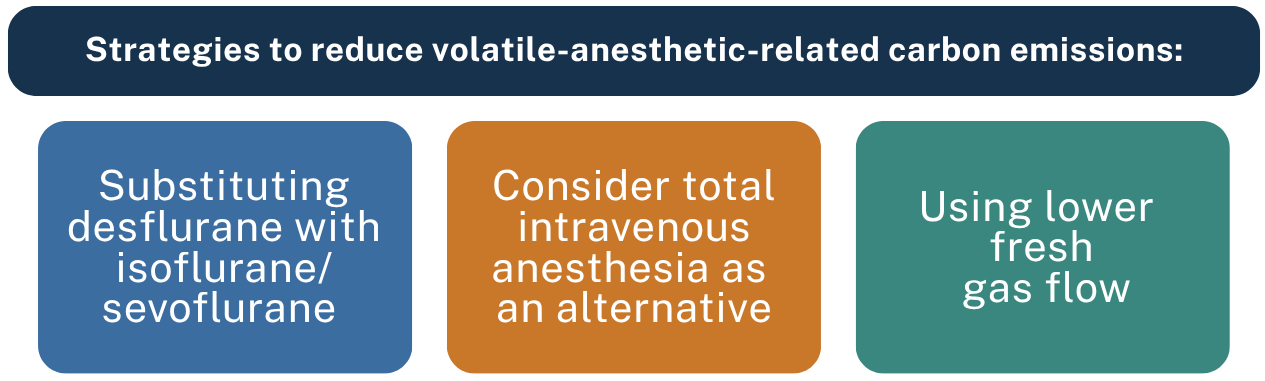
Additionally, mitigation strategies for reducing carbon emissions include:
Substituting desflurane with sevoflurane or isoflurane if volatile anesthetics are indicated
Considering the use of total intravenous anesthesia as an alternative
Minimizing anesthetic waste through lower fresh gas flow
History of Implementation
As the environmental impact of desflurane use has become established, several countries and jurisdictions have implemented desflurane phase-out initiatives. The first health service to ban desflurane was the Scotland National Health Services in March 2023, followed by England’s National Health Services in April 2024. In January 2026, the European Union officially banned the use of desflurane.
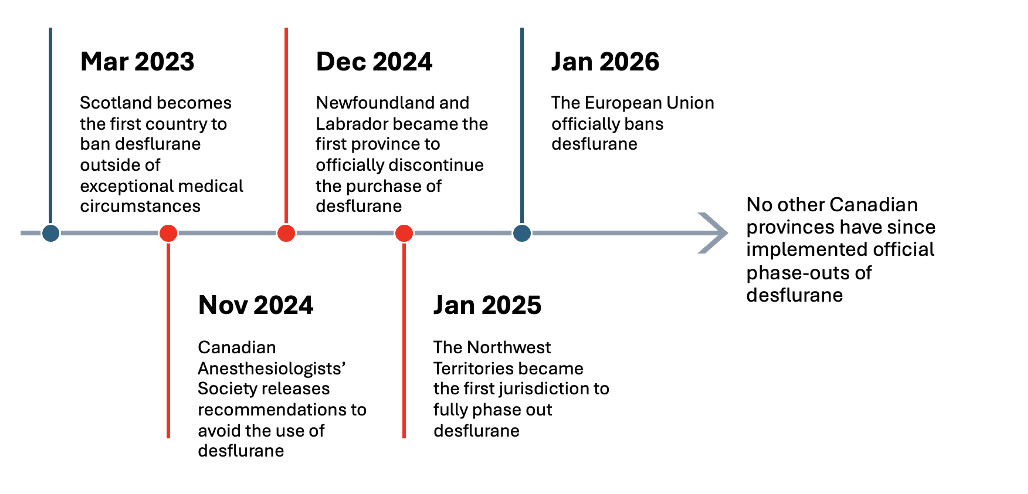
In Canada, the first province to stop purchasing desflurane was Newfoundland and Labrador in December 2024. The next month, the Northwest Territories announced that it would be the first jurisdiction to fully phase out desflurane.
Although several hospitals and healthcare institutions have since removed desflurane from their formularies, no further province-wide measures have been implemented.
In Ontario
The first institution in Ontario to report the removal of desflurane from formulary was Health Sciences North in Sudbury. Subsequently, a growing number of hospitals have eliminated desflurane from routine use.
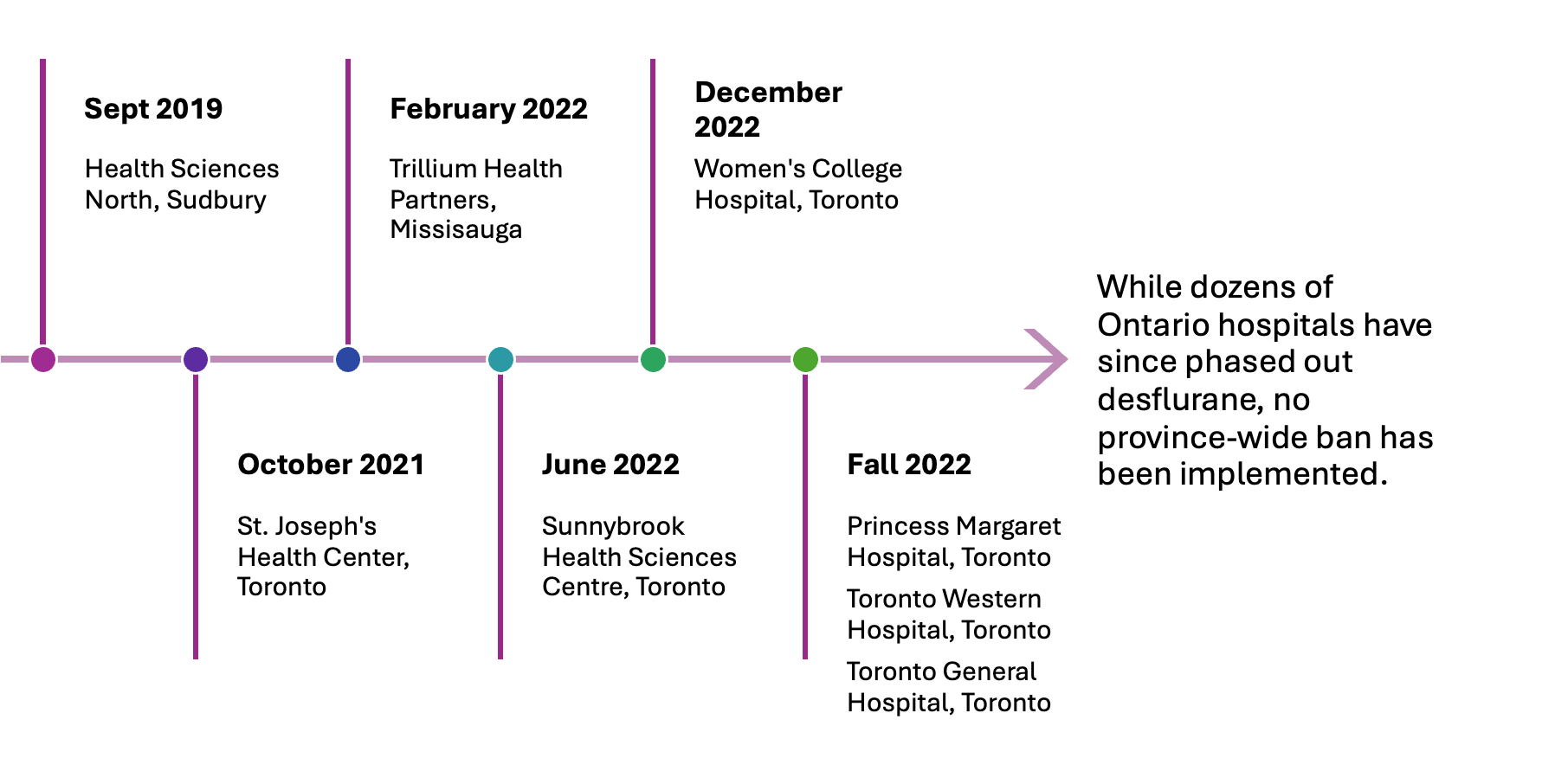
The Ontario Anesthesiologists’ Environmental Sustainability Working Group now maintains a registry of participating facilities. Explore it below (to see the full list of centres, select the “View larger map” option). If your facility has eliminated desflurane and you are not listed, please contact us.
Resources and References
-
Check Out Our Ditch the Des Infographic (link TBA)
Yale Centre on Climate Change and Health: Anesthetic Carbon Emissions Calculator
-
-
-
Andersen MPS, Nielsen OJ, Sherman JD. Assessing the potential climate impact of anaesthetic gases. The Lancet Planetary Health. 2023 Jul 1;7(7):e622–9. doi:10.1016/S2542-5196(23)00084-0 PubMed PMID: 37438003.
Anderson WA, Rao A. Anesthetic Gases: Environmental Impacts and Mitigation Strategies for Fluranes and Nitrous Oxide. Environments. 2024 Dec;11(12):275. doi:10.3390/environments11120275
McGain F, Muret J, Lawson C, Sherman JD. Environmental sustainability in anaesthesia and critical care. British Journal of Anaesthesia. 2020 Nov;125(5):680–92. doi:10.1016/j.bja.2020.06.055
Schwiethal A, Treskatsch S, Michael J, Höft M, Spies CD, Koch S. The Power of Education to Reduce the Carbon Footprint of Volatile Anesthetics in Clinical Practice. Anesthesia & Analgesia. 2025 Oct;141(4):868. doi:10.1213/ANE.0000000000007375
Seibold EL, Wachtendorf LJ, Needham MJ, Munoz-Acuna R, Redaelli S, Suleiman A, et al. Impact of desflurane removal from the operating room on carbon dioxide emissions at a tertiary academic medical centre: a retrospective cohort study. British Journal of Anaesthesia. 2025 Dec 1;135(6):1635–44. doi:10.1016/j.bja.2025.05.031 PubMed PMID: 40675839.
Sulbaek Andersen MP, Nielsen OJ, Sherman JD. Assessing the potential climate impact of anaesthetic gases. The Lancet Planetary Health. 2023 Jul 1;7(7):e622–9. doi:10.1016/S2542-5196(23)00084-0
van Nieuwenhuizen KE, Michels CTJ, Both IGIA, Guinée JB, Jansen FW, Panel on behalf of the DE. Evidence-Based Integration of Environmental Sustainability into Clinical Guidelines for Operating Rooms: A Systematic Review. Annals of Surgery. 10.1097/SLA.0000000000006756. doi:10.1097/SLA.0000000000006756
Vollmer MK, Rhee TS, Rigby M, Hofstetter D, Hill M, Schoenenberger F, et al. Modern inhalation anesthetics: Potent greenhouse gases in the global atmosphere. Geophysical Research Letters. 2015;42(5):1606–11. doi:10.1002/2014GL062785
White SM, Shelton CL, Gelb AW, Lawson C, McGain F, Muret J, et al. Principles of environmentally-sustainable anaesthesia: a global consensus statement from the World Federation of Societies of Anaesthesiologists. Anaesthesia. 2022;77(2):201–12. doi:10.1111/anae.15598
Wyssusek K, Chan KL, Eames G, Whately Y. Greenhouse gas reduction in anaesthesia practice: a departmental environmental strategy. BMJ Open Qual. 2022 Aug 24;11(3). doi:10.1136/bmjoq-2022-001867 PubMed PMID: 10.1136/bmjoq-2022-001867.
Yamakage M. Sustainable anesthesiology: evidence-based strategies for environmental stewardship in perioperative care. J Anesth. 2026 Jan 31. doi:10.1007/s00540-026-03674-3
Hammer S, Eichlseder M, Klivinyi C, Lang-Illievich K, Moser A, Pichler A, et al. Effects of departmental green anaesthesia interventions on carbon dioxide equivalent emissions: a systematic review. British Journal of Anaesthesia. 2025 Jul 1;135(1):79–88. doi:10.1016/j.bja.2025.03.038
-
Newfoundland and Labrador: Decentering Desflurane: A climate action success story
Island Health, BC: Desflurane greenhouse gas reduction success in anesthesia (March 2026)
Anesthetic Gas Switch in Quebec: Shift is slow, some say (Aug 2025)
New Brunswick: Greener possibilities on the operating table at Fredericton hospital (Dec 2023)
Major B.C. Trauma Hospital Switches Anesthetic Gas to Reduce Carbon Footprint (June 2022)
BC Anesthesiologists Reduce Carbon Footprint by Choosing Wisely (Jan/Feb 2021)