
Why Can’t You Eat Before Anesthesia: A look at NPO guidelines & what they mean for you
/Surgery is one of the most stressful experiences many of us will ever have to undergo. So, it can seem rather cruel that one of our best sources of comfort —food — is denied to us in the lead-up to surgical procedures.
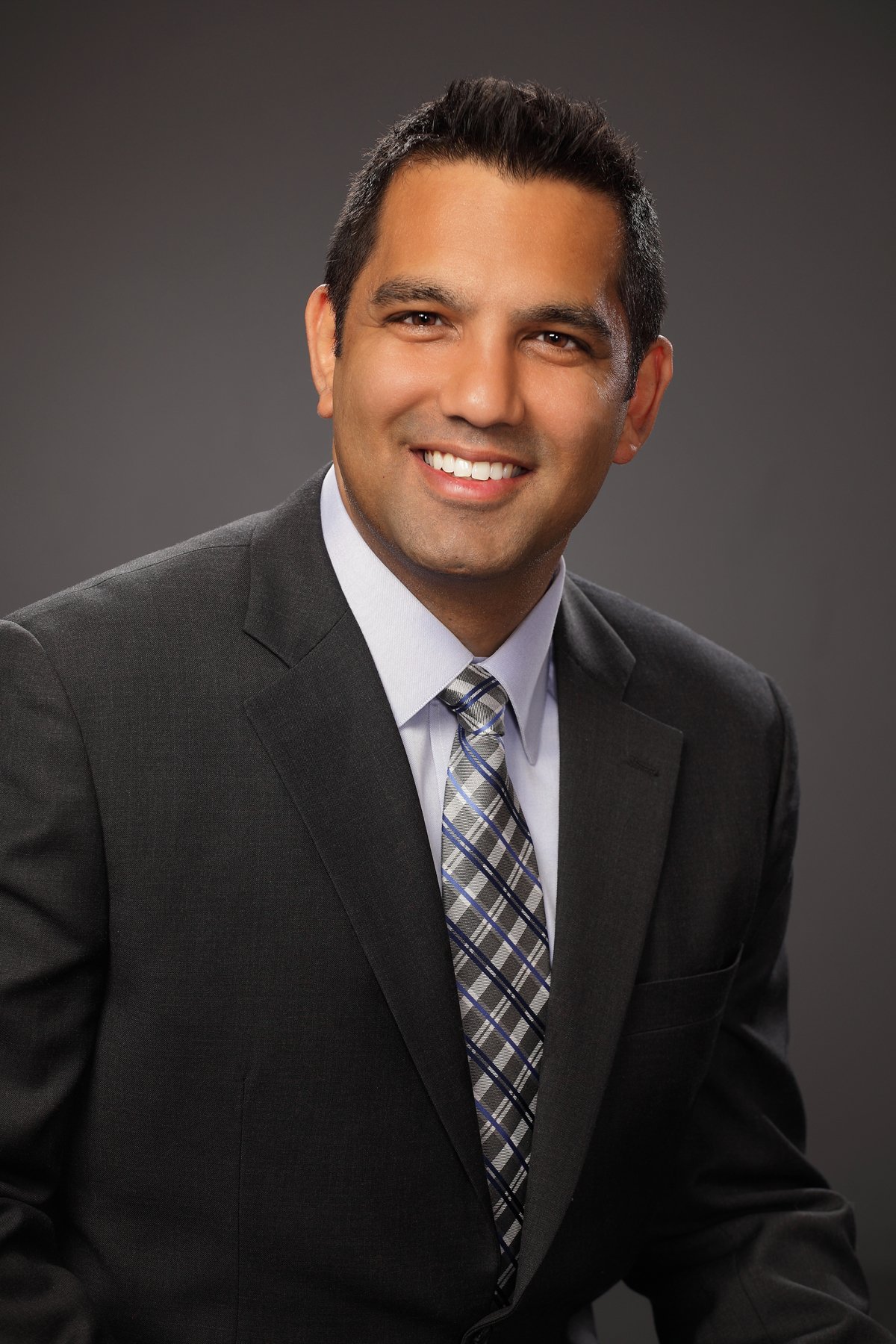
Dr. ROhit Kumar
But there is a very good reason why you’re not allowed to eat before surgery or any other procedure involving sedation: “It’s to prevent the risk of aspiration, which can be very serious,” explains Dr. Rohit Kumar, an anesthesiologist with Trillium Health Partners and past Chair of Ontario’s Anesthesiologists.
Aspiration is when stomach contents enter your lungs and can result in lung damage, pneumonia, or other dangerous conditions. This can occur because, when under anesthesia, your muscles and reflexes (such as coughing) are relaxed to the point where it is possible for stomach contents to enter your lungs.
To reduce your risk of aspiration, you’ll be told not to eat or drink before your procedure, a practice known as NPO. This acronym is short for the Latin phrase nil per os and means "nothing by mouth." Being NPO also has some other benefits, such as reducing post-operative vomiting and nausea.
While aspiration is rare, it can be life-threatening. Because of this, if you eat or drink before your elective procedure, “Your surgery will be cancelled or delayed until NPO guidelines are met,” says Dr. Kumar, adding that your procedure may be cancelled, “Even if you have waited months for surgery.” This may cause further delays, as your procedure will have to be rebooked by the surgeon in their next available slot.
Per the latest Canadian Anesthesiologists Society guidelines, being a NPO patient generally means you can’t eat solid food for the six hours prior to receiving anesthesia, with consumption of heavier foods stopped by the eight-hour mark. This includes general anesthesia, as well as the moderate/conscious sedation many people are given when undergoing procedures such as colonoscopies and endoscopies.
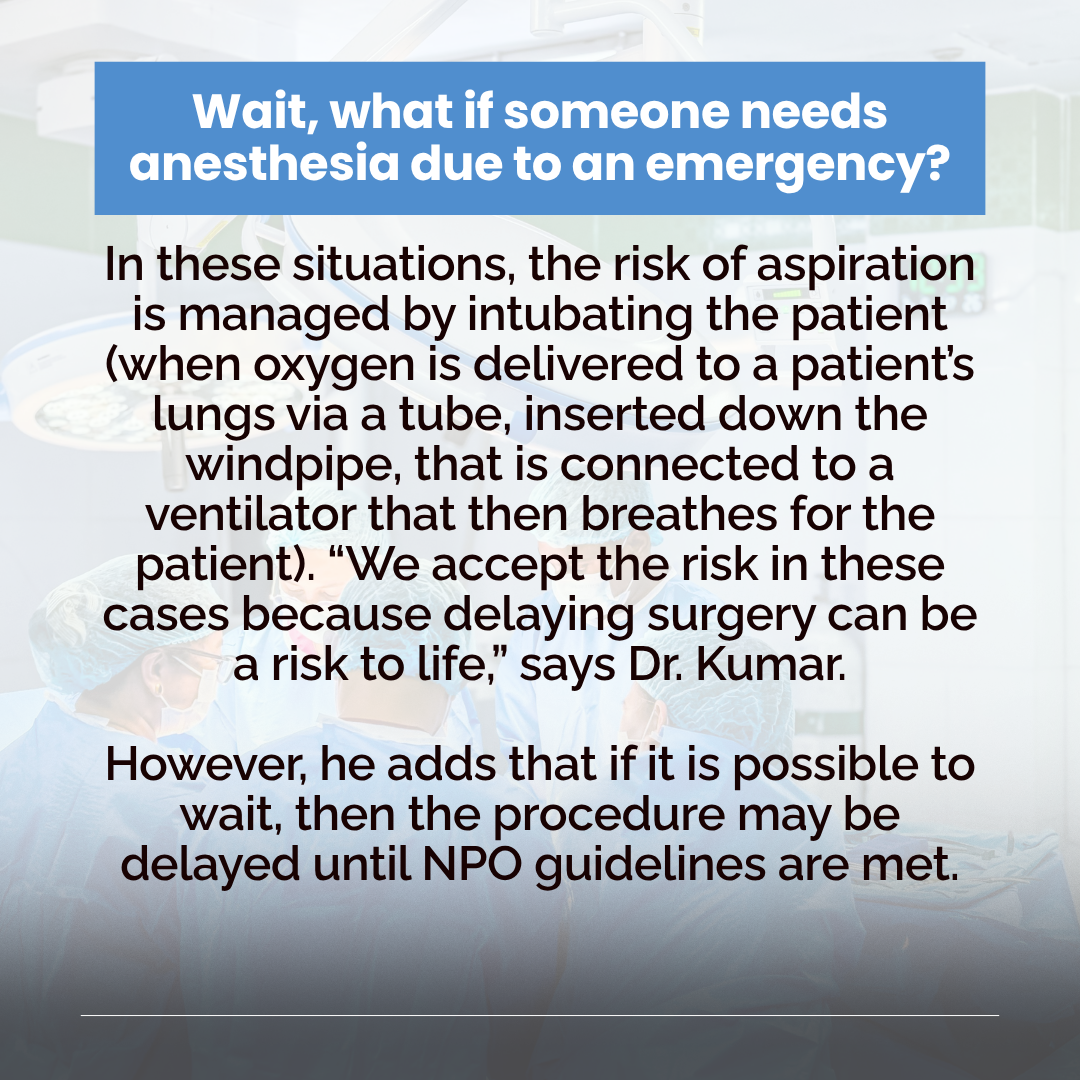
Note that some patients may be given slightly different instructions depending on their health and the procedure. Please always follow the instructions provided by your health-care team.
The NPO guidelines apply to all ages, including children (which is why they are often scheduled for surgery as early in the day as possible) and apply to infant formula, non-human milk, and expressed, fortified breast milk.
They are a little different for young children who consume breast milk; they can generally nurse or have a bottle up until four hours before surgery.
While you’re not allowed to enjoy your favourite breakfast pastry before your surgery, you are now encouraged to sip on up to 500 ml of clear liquids up to two to three hours before your surgery to avoid dehydration and insulin resistance (kids can consume clear fluids up to one hour before their procedure). Consuming clear liquids also helps reduce the body’s natural stress response, which we try to avoid triggering before surgery to ensure the smoothest course possible for your perioperative experience.
This includes drinking clear fruit juices, such as white cranberry juice, which lets you carb-load before your procedure. However, once you hit that two to three hour mark—the exact cut-off point will depend on your hospital or doctor—you cannot eat or drink anything until after surgery.
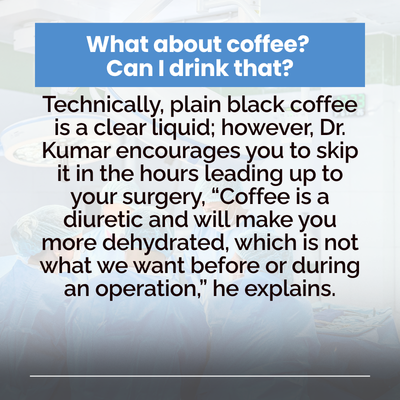
This approach to clear fluids is fairly new, so don’t be surprised if someone shares their NPO experience from a few years ago that included absolutely no food or liquid of any type after midnight. Please ignore their “words of wisdom” about skipping clear liquids and instead, follow the instructions given to you by your health-care team.
Prescription Medicine, Vitamins & supplements
Be sure to let your health-care team know about all medications, vitamins, and supplements you take. With some exceptions (including GLP-1 medications, please see our article dedicated to these drugs), prescription medications can be taken as directed, up to two hours before surgery. Dr. Kumar adds that it’s fine to take that medication with a few sips of water.
Vitamins and supplements are a different story. “We typically have patients hold most of their vitamins, minerals and herbal medications for up to two weeks before surgery unless directed by their doctor to continue them,” explains Dr. Kumar.
We know that following NPO guidelines can be challenging, and that it’s tempting to find a hack to deal with them. However, Dr. Kumar explains that in the days leading up to your procedure, it’s best to follow your normal diet and routine. While it might seem like a good idea to eat extra the day before your surgery, he discourages this approach, “Sometimes eating an extra-large meal can make you feel even hungrier the next day.”
The best thing you can do is remind yourself that any discomfort you feel around being an NPO patient is temporary and that it’s what is best for your health.