

A Quick Look at Obstetric Anesthesia Care Part 1: Epidurals
/Every year, Ontario welcomes roughly 144,000 newborns. Most of these babies make their debut in a hospital, where patients are supported by obstetricians, midwives, nurses, and other health-care providers.
This community of carers includes many of our members in the form of obstetric (OB) anesthesiologists. They are anesthesiologists who have the skills and knowledge to provide everything from a pain-relieving epidural to a lifesaving airway maneuver. They also play a particularly critical role for the approximately 30% of births that are caesarean deliveries, a topic we’ll dive deeper into in an article we’ll share next month.

For most anesthesiologists, OB anesthesiology is one of several forms of anesthesia care they practice. But for some, such as Dr. Ron George, it is their primary focus.
For over 20 years, he’s been not just practicing OB anesthesiology, but also leading research into improving that care for patients (learn a bit more about Dr. George in our Instagram Spotlight with him). He is currently a professor at the University of Toronto and the Director of Obstetric Anesthesia at Toronto’s Mount Sinai Hospital, home to Canada’s largest and most comprehensive academic obstetrics program.
When it comes to labour, anesthesiologists are often thought of only in the context of pain relief. But, says Dr. George, “OB anesthesiology is about safety, support, and being present for some of the most critical moments in care. The anesthesiologist is a continuous part of the team, helping patients stay comfortable, responding to emergencies, and ensuring both mom and baby are safe, while also supporting a birth experience that aligns with the patient’s goals.”
His words are echoed by Dr. Daniel Cordovani, a staff anesthesiologist at Hamilton Health Sciences, and a professor at McMaster University, where he is also the Associate Chair of Education and, until recently, the school’s OB Anesthesia Fellowship Director.
Says Dr. Cordovani, “Our role is not only to improve comfort, but also to support overall safety. If complications arise—such as postpartum hemorrhage—we are already present and can act quickly.”
Epidurals: The Key Facts
While anesthesiologists play various roles when it comes to labour and delivery, for most patients, the primary touchpoint for anesthesia care is the epidural, which Dr. George calls “The gold standard for labour analgesia in modern obstetric care.”

In Ontario, a labour epidural is placed by a physician with anesthesia training, typically an anesthesiologist or a family physician with enhanced anesthesia skills (one of our FP-A members). But while the initial placement is performed by a doctor, monitoring, some troubleshooting, and other ongoing support once it’s in place generally involves the obstetric nurse, who has additional training in epidural management. This team-based approach, “Ensures both procedural expertise and continuous bedside care throughout labour,” says Dr. George.
Labour epidurals are quite common in our province and are used in around 50-60% of labours. However, Dr. George notes this number can vary depending on the hospital. He explains that a large centre that offers around-the-clock anesthesia care, such as Mount Sinai where he works, can see epidural rates as high as 80 to 90%.
“In smaller or rural hospitals, it can be more of a challenge,” says Dr. Cordovani. He explains that these centres may not have 24/7 in-house anesthesia coverage, or there may only be one physician providing coverage for multiple areas, including operating rooms, resulting in scenarios where an anesthesiologist isn’t available to administer an epidural. An overall shortage of anesthesiologists in rural areas, as well as difficulty in finding backup coverage, has unfortunately made these scenarios more likely.
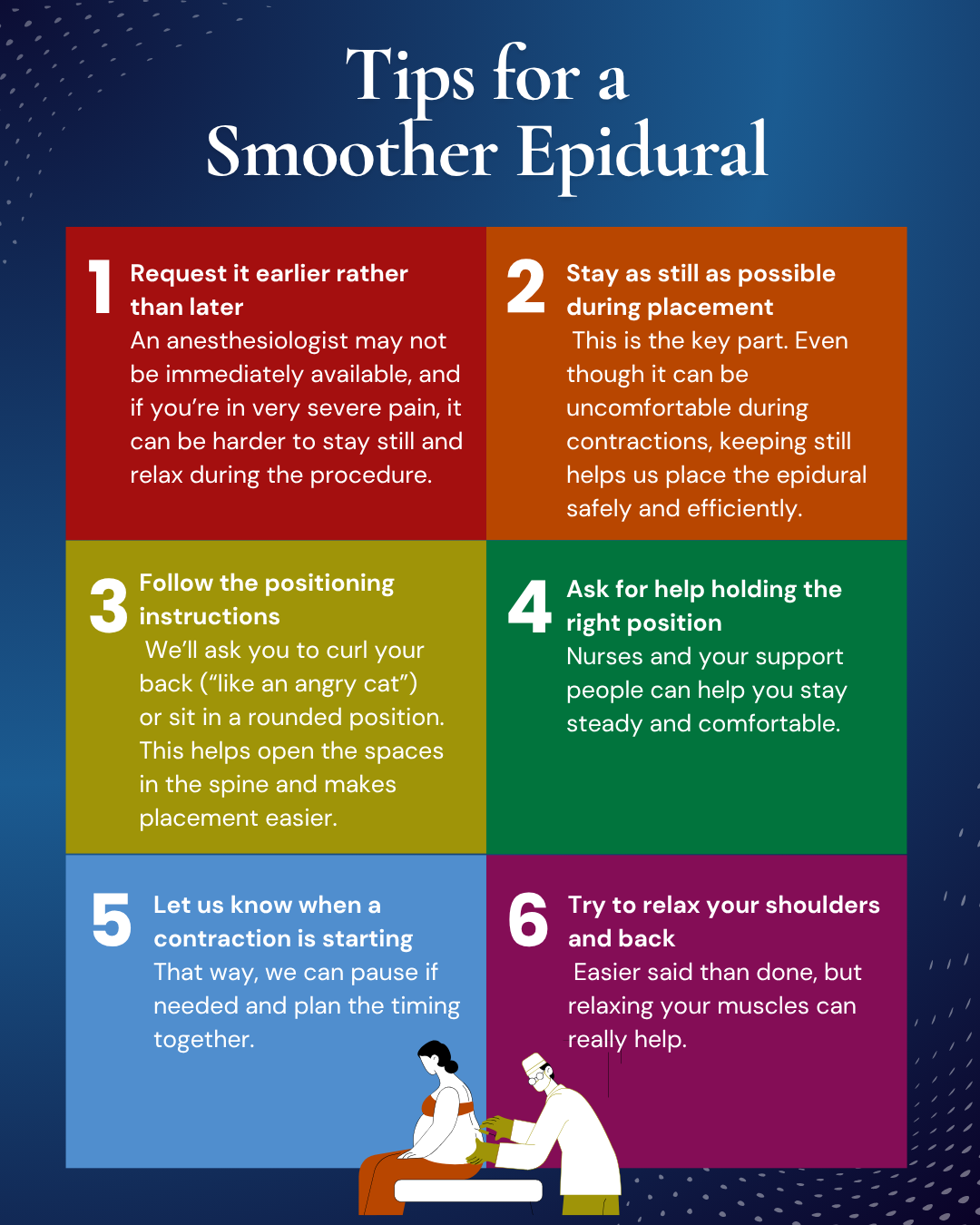
He also adds that timing can always be an issue, regardless of the hospital size, as even the best-staffed centre may find itself having to delay epidurals due to emergencies and other urgent cases. “It’s why we often recommend asking for one earlier rather than waiting until things become very intense.”
Thankfully, alternative pain relief options are available, such as IV pain medication, though they generally aren’t quite as effective as an epidural.
That effectiveness is just one reason why epidurals are more popular than ever. Dr. George observes that over the span of his career, demand for epidurals has remained strong or increased, which he believes is likely due to a “Greater emphasis on patient choice, improved access, and the normalization of epidurals as part of routine, patient-centred maternity care.”
Receiving An Epidural
Other than asking for it sooner, there is no “ideal time” for an epidural, explains Dr. Cordovani, “There’s no need to wait for a specific stage of cervical dilation. If someone is in labour and would like pain relief, an epidural can be provided safely.”
Since getting an epidural limits a patient’s ability to be ambulatory, some people prefer to delay the procedure. But for others, it may be preferred to place the epidural prior to any pain or even before labour has begun. “For example,” says Dr. Cordovani, “If someone is having an induction of labour and has certain medical conditions—such as heart rhythm issues or severe asthma—we may want to avoid the stress and pain of contractions triggering complications. In those cases, placing the epidural early means it’s ready to go, and we can start the medication as soon as discomfort begins.”
So, what exactly happens during an epidural?
Dr. George explains that it starts with a chat with the anesthesiology professional, who reviews key health details as well as the patient’s labour goals and ultimately confirms that an epidural is the right fit. Ideally, this process starts before intense pain/contractions; however, since labour is unpredictable, flexibility is critical.
When it’s time to place the epidural, the patient will either sit up or lie down and then curl their back, like an arching cat, to open the spaces in the spine.
Next, a patch of skin in the lower back is numbed via an injection of local anesthetic. This is often described as the most uncomfortable part of the whole experience, but is still significantly less painful than the pain from contractions.
After the skin is numb, a needle is used to thread a very thin, flexible catheter into the lower back. Yes, this is “the big needle,” but don’t worry, it comes out, leaving in place only the soft, flexible tube. During this step, Dr. George says, “Curling your back and staying as still as possible during contractions helps the anesthesiologist place the epidural quickly and safely.”
Once the tube is properly placed into the back, medication is injected into the epidural space via a pump, using the catheter as a conduit. Most patients will feel the effects within a few minutes. Medication will continue to flow into the catheter over the course of labour, and adjustments to this flow can usually be made as needed. Depending on the setup, some patients may have a button that lets them “push” an extra dose of medication when needed.
For safety reasons, most hospitals have restrictions or limitations on walking and other out-of-bed movements for patients who are receiving an epidural. These restrictions vary by institution, so patients should speak with their health-care team to learn any specific details.
After labour is over and there is no longer a need for the epidural, a nurse will remove the catheter. This is generally a quick and painless process. The puncture site where the catheter was inserted will then be covered with a bandage. It is safe to bathe immediately following the removal of an epidural.
If the epidural does not provide adequate pain relief, it’s important the patient speaks up. Dr. George emphasizes that, “It isn’t a one-shot procedure; it’s a dynamic process with continuous troubleshooting to keep them comfortable and safe.” They may involve adjusting doses, repositioning or replacing the catheter, or using alternative approaches if needed.
Also continuous is monitoring of the patient's vitals, including blood pressure and the baby’s heart rate.
“Overall, it’s a team effort—we’ll guide you through it, but your timing, positioning, and stillness make a big difference in how smooth the process is,” adds Dr. Cordovani.
Let’s Bust Some Epidural Myths
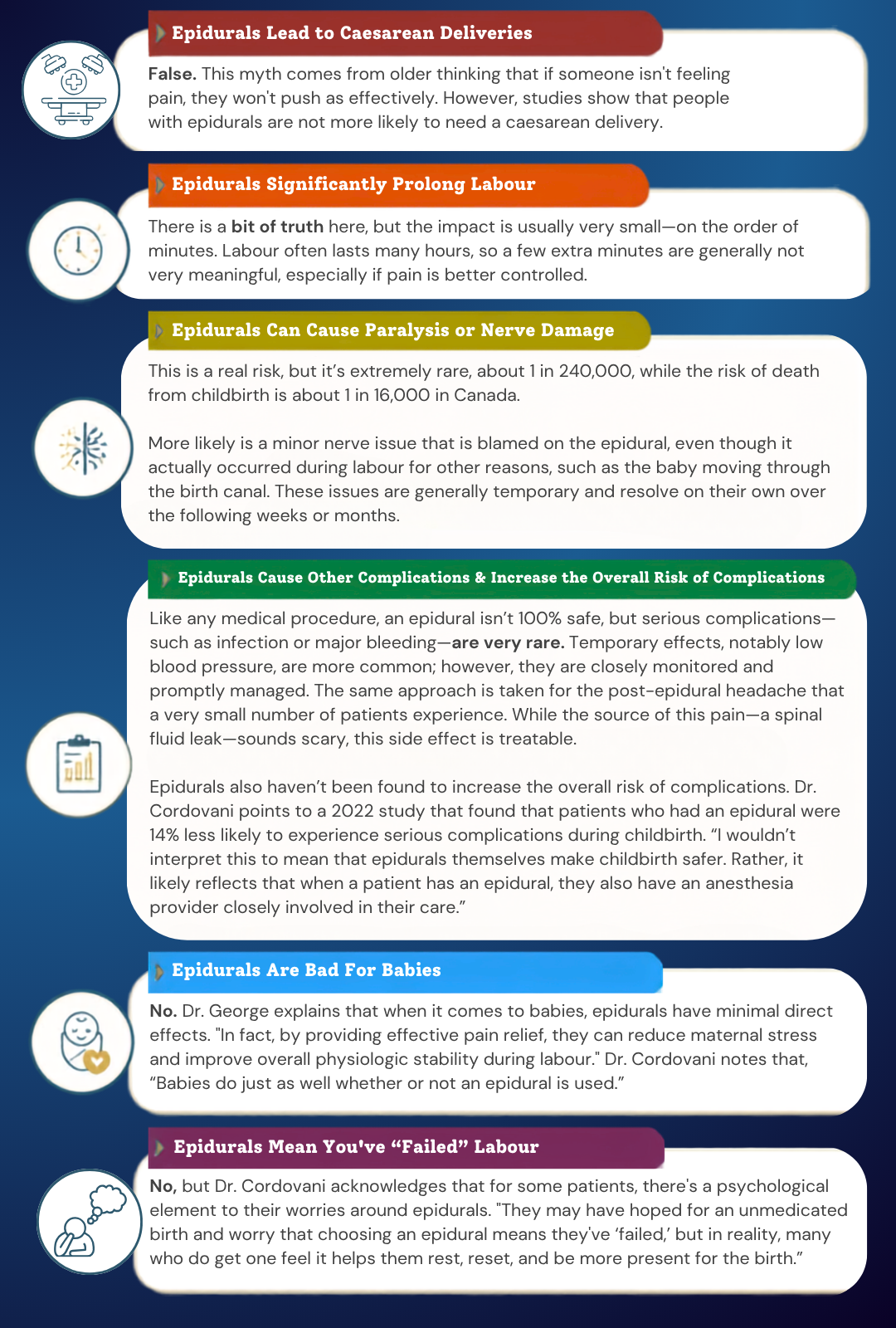
“In appropriately monitored settings, epidurals have a strong safety profile with a long track record of use worldwide,” explains Dr. George.
But despite their established record of safety and effectiveness, a peek inside any online parenting group shows that epidurals are a topic that generates strong opinions, and more than a little misinformation. So, let’s clear up a few of those myths right now.
What’s In an Epidural?
Some patients are understandably concerned about the medication used in epidurals. Dr. Cordovani explains that while various drugs can be used, an epidural usually has two parts:
Local Anesthetic: This is a freezing medication, such as bupivacaine or ropivacaine, that numbs the nerves and blocks pain from the lower body. “We use low doses so patients still have movement in their legs and can take part in labour,” says Dr. Cordovani.
Opioid: Often, a very small amount of fentanyl is added to improve pain relief.
Dr. Cordovani explains that by using both types of drugs together, physicians can use less of each, minimizing side effects. For example, by minimizing the amount of local anesthetic used, feelings of heaviness or weakness in the patients’ legs are minimized, and it is easier to maintain good blood pressure.
“My perspective is that, unless there is a medical reason such as an allergy or a history of exaggerated side effects like itchiness, it is usually in the best interest of the patient to have this combination,” he says.
He acknowledges that some patients may be concerned by the use of fentanyl, but says that the risk of addiction from this very low and controlled amount is negligible.
Dr. Cordovani adds that because the medication is delivered to the epidural space, and not in the bloodstream, the dose is much lower, with only a fraction of it absorbed. This means that hardly any of the medication will be passed along to the baby. “There is a long, well-established track record from thousands of epidurals using fentanyl, with no meaningful differences in newborn outcomes,” he explains, adding that if a patient doesn’t want fentanyl used, there are alternatives.
Ultimately, notes Dr. George, “Epidurals are about choice, not obligation; there’s no single ‘right’ decision, and patients can plan, change their mind during labour, or choose not to have one at all.”
For more information about epidurals, he recommends patients visit the Painless Push, a website maintained by the Society for Obstetric Anesthesia and Perinatology (SOAP), while Dr. Cordovani points to LabourPains, a U.K.-based website with more scientifically backed information.
***Please watch for our next article on OB anesthesia, which will focus on the role our members play during caesarian deliveries.***